Skip to content

Supermemory n8n community node

Published with provenancePublished with provenancenpm holds a signed attestation linking this release to the exact source commit and CI run that built it, so you can check what you install was built from the code it claims.What provenance means

@nativeship/n8n-nodes-supermemory

Use the Supermemory n8n node to add documents and memories, search stored knowledge, and retrieve user profiles in your workflows

Install in n8n

Open Settings → Community Nodes → Install and paste this name.

@nativeship/n8n-nodes-supermemory

n8n Cloud installs only community nodes verified by n8n, so this one needs self-hosted n8n.

What you can do with Supermemory in n8n

38 operations across 8 resources

Connections

9 operations

  • Delete connection by ID — Delete a specific connection by ID
  • Get Connection — Get connection details with id
  • Fetch resources — Fetch resources for a connection (supported providers: GitHub for now)
  • Configure connection — Configure resources for a connection (supported providers: GitHub for now)
  • Create Connection — Initializes an external integration connection and generates an authorization redirect URL
  • Get Connection by Provider — Retrieves connection details by provider type and container tag filter
  • Get Connection Documents — Lists all documents indexed from a specific integration provider and container tags
  • Sync Connection — Triggers a manual background sync to import documents from a connected provider
  • Get Many Connections — Lists external service integration connections filtered by container tags

Container Tags

6 operations

  • Delete Container Tag — Deletes a container tag along with all linked documents and memories
  • Get Container Tag — Retrieves settings, display name, entity context prompt, and profile buckets for a container tag
  • Get Many Container Tags — Lists all spaces and container tags with document counts, memory counts, and activity dates
  • Get Merge Status — Retrieves the execution progress and state of an active container tag merge job
  • Update Container Tag — Updates the display name, custom entity context prompt, or bucket definitions of a container tag
  • Merge Container Tags — Queues a background job to merge two container tags and consolidate their data into a target tag

Content Management

5 operations

  • Forget Memory — Soft-deletes a specific memory entry by marking it as forgotten
  • Update Memory — Creates a new version of an existing memory entry while preserving change history
  • Create Memories — Creates entity-centric memories directly into vector storage, bypassing document extraction
  • Forget Matching Memories — Uses semantic search or explicit IDs to mass-forget memories matching a prompt or query
  • Get Many Memories — Lists active memory entries, version histories, and source document relations for a container tag

Documents

6 operations

  • Get Document — Retrieves full details, metadata, status, and extracted memories for a specific document
  • Get Document Chunks — Retrieves the ordered text and image chunks extracted from a specific document
  • Get Document File URL — Generates a temporary presigned download URL for a document's uploaded source file
  • Get Processing Documents — Retrieves in-flight, queued, or failed documents currently going through extraction
  • Get Many Documents — Retrieves a paginated list of documents filtered by container tags, metadata, or dates
  • Search documents — Search memories with advanced filtering

Ingest

7 operations

  • Bulk Delete Documents — Deletes multiple documents simultaneously by a list of document IDs.
  • Delete Document — Permanently deletes a specific document by its unique ID or custom ID.
  • Update Document — Updates the content, metadata, or container configuration of an existing document
  • Add Document — Ingests and processes content, URLs, or text into a containerized document
  • Batch Add Documents — Ingests up to 600 documents in a single request with metadata and container scoping
  • Upload Document File — Uploads and processes a local binary file (PDF, text, image, or media) into a document
  • Ingest Conversation — Ingests or updates structured multi-turn conversation messages under a conversation ID.

Profiles

2 operations

  • Get Profile — Retrieves static and dynamic contextual profile facts for a specific container tag
  • Get Profile Buckets — Retrieves effective profile category bucket definitions for a given container tag.

Recall & Search

1 operation

  • Search Memories — Performs low-latency semantic and hybrid search across memories and document chunks

Settings

2 operations

  • Get settings — Get settings for an organization
  • Update settings — Update settings for an organization

About Supermemory

The Supermemory n8n node brings long-term memory and document search into your workflows. You can add content to Supermemory, retrieve relevant information later, and work with profiles tied to a user or project.
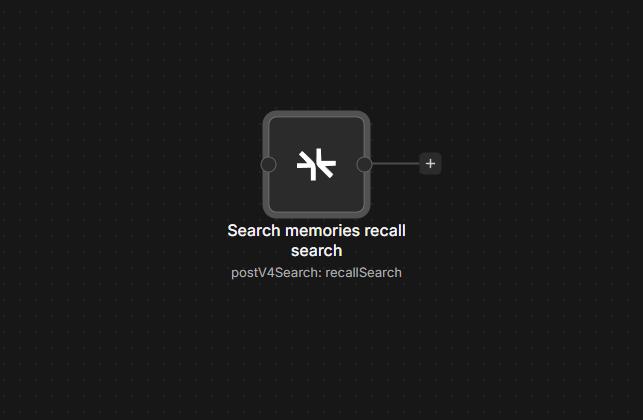
Supermemory node on an n8n workflow canvas

Connect Supermemory to n8n

  1. Install @nativeship/n8n-nodes-supermemory from Settings → Community Nodes in n8n.
  2. Create an access key in your Supermemory account.
  3. In n8n, create a Supermemory API credential and paste the key into Access Token.
  4. Add the Supermemory node to a workflow, then choose a resource and operation.
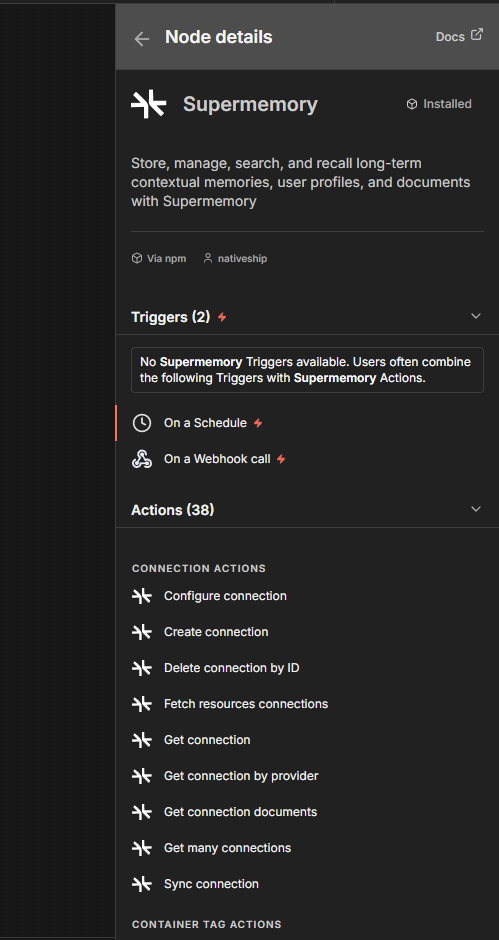
Supermemory node details in n8n showing memory, document, and search actions

What you can do

Use Content Management → Create Memories to store facts you want to recall. You can also update, list, or forget memories.

Use Ingest → Add Document or Upload Document File to add content. The node can also ingest conversations and manage existing documents.

Use Recall & Search → Search Memories to find relevant information. Profile → Get retrieves the contextual profile for a container tag, such as a user or project identifier.

Built with NativeShip

NativeShip created and manages this Supermemory node. It helps SaaS companies launch official, verification-ready n8n community nodes in minutes and keep them updated as their product changes, so customers can use the product in their own workflows.

Want to launch an n8n node for your SaaS? Explore NativeShip.

Supermemory questions

Yes. Use Ingest → Add Document for text or a URL, or Upload Document File for a file available in your workflow.

Yes. Use Recall & Search → Search Memories and provide a query. The node also has a document search action.

Use a consistent Container Tag when storing and retrieving information. The tag scopes the memories or profile you ask Supermemory to return.

Yes. The node supports use as an AI Agent tool, so the agent can call its selected Supermemory action during a workflow.

Yes. NativeShip helps SaaS companies launch and maintain n8n community nodes that are ready to submit for verification. Your customers can then use your product in their own n8n workflows.

Ready to launch your own n8n community node?

Give your customers another way to use your product.

Start building